|
Replacement NiMH Battery packs for the Chevrolet
S-10EV
The EV Bones Battery Electric Vehicle service facility is purpose designed
to accommodate the Chevrolet S-10EV.
The vehicle is elevated on an asymmetrical hydraulic lift to provide
clearance in lowering the battery pack for service. The pack is lowered
using a hydraulic electric platform lift, designed to support the 1800
pound pack during removal, service, and re installation processes.
The Chevrolet S-10EV uses 26 batteries (VRLA or NiMH) contained in a
sealed, steel-reinforced resin molded box beneath the truck bed,
centered in the frame rails. The low center of gravity provides excellent
handling characteristics in spite of the considerable pack weight.
An efficient heat pump driven thermal management system provides both
heating and cooling for the batteries to maintain excellent
temperature control during battery charge. Ambient air recirculation
is used to equalize the battery pack temperature while driving.
The sealed battery pack is an advantage in hostile and dirty environments.
It has the distinct disadvantage of being unable to dispose
of the heat that results in an accelerated self discharge when the
vehicle is parked for long periods away from a charging station when
cooling is activated while under charge. We advise the customer to
have charging facilities available at home and also while at work.
An image of an S-10 NiMH battery pack with the sealed cover removed
is shown below.
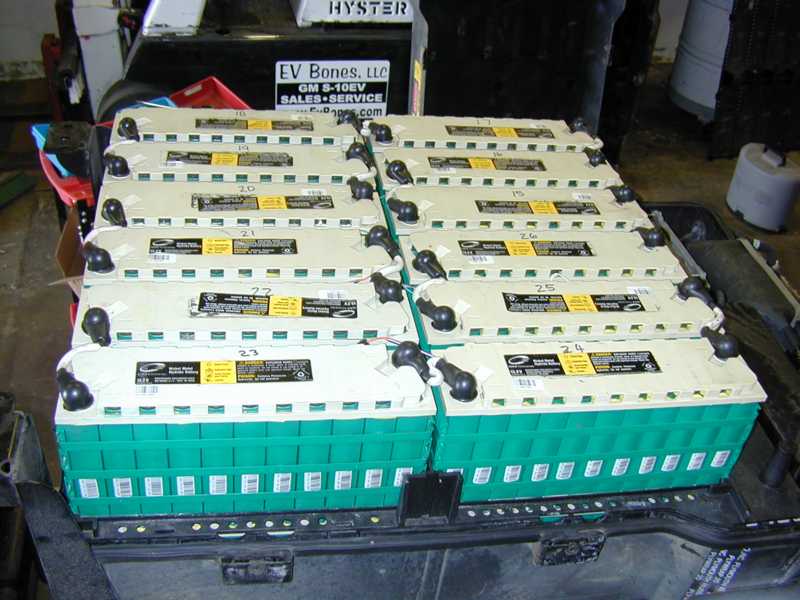
The batteries are arranged as twelve on top, and fourteen on the bottom.
The center support shelf covers the lower deck of batteries in the pack.
An S-10EV NiMH pack has up to 29 kWh of energy when fully charged.
The GM/Ovonic NiMH EV battery was purpose designed for the EV1 and
S-10EV.
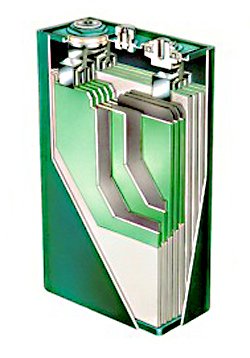
Each battery is composed of eleven individual cells (one shown at right)
connected in series to form a completed battery module.
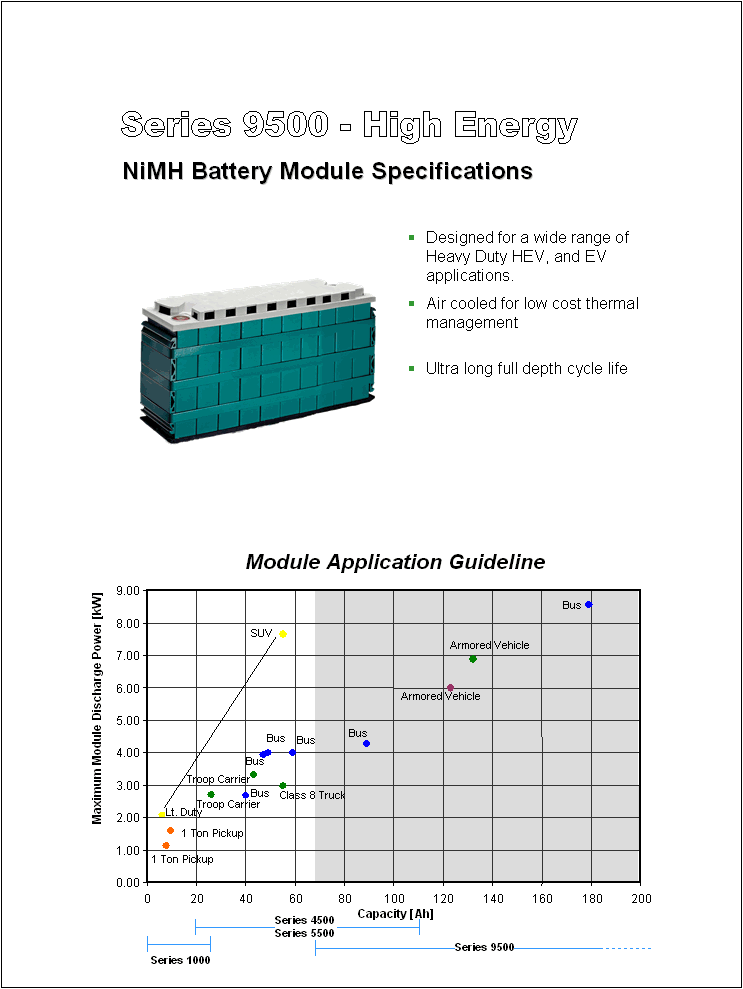
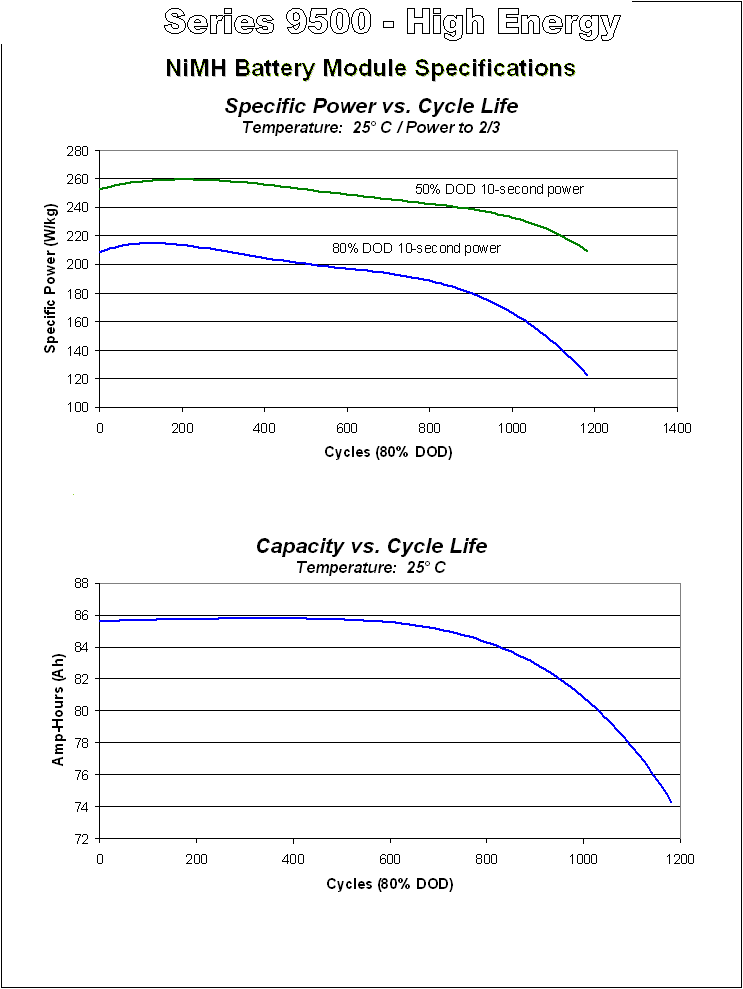
Battery voltage is 13.2v, and rated current is 85Ah @ 25 degrees Centigrade, giving a Traction Pack resting Votage of 343V.
When compared to the energy density per pound of valve regulated lead-acid,
the NiMH battery provides nearly 2X the available energy, and 3X service
life.
NiMH has it's limitations. Heat directly affects life and performance
of these batteries.
Careful charge management is required in order to achieve maximum capacity
and service life. Thermal management (cooling) is required in both charge
and discharge cycles.
Added by the moderators - Not in Jeff's original website.
NiMh Charging voltages of 380V to 410V are normal, & up to 460V during the HTCM commanded Balancing Charge every 30 days.
For charging specifications, the EV1 and S10-E pack Battery Pack Control Module relied on a complex Battery Pack Monitor and inductive charging system rather than a static high-voltage target, managing active thermal limits to prevent pack degradation: The BPCM measures the pack temp sensors and -Delta on each module. The tolerance is 0.4V difference between battery modules for "Service Soon" and 0.7V for "Service Now"
Ovonics NiMh modules:
Nominal Cell Voltage: 1.2V
Nominal Module Voltage 13.2V
Nominal Pack Voltage: 343V
Charging Voltage per cell: 1.4V - 1.6V
Charging Voltage per Module 15.4V - 17.6V
Charging Voltage Total Pack: ~ 380V - 410V, and 460V during Balancing charge
Ovonics say 13.5V per 11 cell module is Charge Complete. We think 13.6V is correct, because Other Ovonics data sheets say that End of Charge is determined by temperature and voltage at 1.45V to 1.5V per cell or or 16.5V per 11 cell module. When left without a trickle charger the Ovonics cells dissapate up to 10% of the charge in the first few hours.
Termination Method: The advanced Delco battery management system primarily utilized -dV/dt (negative delta voltage) to safely terminate the charge cycle and prevent thermal runaway.
NOTES:
1. EV1 and S10-E Traction Packs will Self-disharge to zero after 90 days, because the Auto Disconnect Module is powered from the Traction Pack by an internal DC to DC power supply on the Auto-Disconnect Module's Circuit board.
2. The BPCM measures Amps In and Amps Out, Distance travelled, Pack Voltage and other items to estimate a True SOC which is communicated around the vehicle and to the Magna charger on the J1850 bus. Then 15% is deducted from True SOC and the new SOC value is sent on the UART Bus to the Dash Instrument Cluster. This often errors with outside charging of the Traction Pack, reulting in lower pack percentage availability. Something range extenders and many Lithium updaters have discovered. But do not worry - We have a solution - New BPCM and PIM programming for NMC and other chemistries.
3. Out of vehicle parallel charging of 5 individual NiMh modules from 6.4V for 72 hours on a cooling plate has recorded 18.6V charging voltage using semi-regulated PbA resistance chargers with no measuarable heating of the NiMh modules. Maximun current was 2-4 Amps per module. The Cooling plate was an indoor concrete slab. We were "Waking -Up" old stock NiMh modules. Final complete charging and balancing was completed in the S10-E after resetting Low Voltage error codes using a Tech 2, 3 times.
4. When stuck, tow the Impact, EV1 or S10-E to charge via regen as the limits are mostly ignored by the BPCM during regen. A good solution!
5. On our S10-E with a NiMh charging program and a 2023 NMC Pack installed the BPCM was signalling Charge complete at 351.25V so that must be within the "Full Voltage" range for the NiMh program, which makes 13.5V "Full" in the NiMh EV1 & S10-E programming.
Back to Jeff's original page now..
Performance detail and specifications can be downloaded from the links
below.
Page1
Page2
Page3
|
|
The VRLA battery equipped 1997 and 1998 Chevrolet S-10EV can now be
upgraded to the Ovonic NiMH battery pack.
An upgrade to NiMH for both 97 and 98 model year S-10E is charged as
a flat rate of $8000.00 excluding all shipping costs.
Additionally, there may be reliability items required on your vehicle,
and are not included in the cost of the upgrade.
The vehicle must be shipped to our facilities for the NiMH upgrade.
We do not ship the vehicle battery packs.
Discounted vehicle transport can be arranged by us. Typical turnaround
time for upgrade is two (2) weeks.
Both the PIM (Power Inverter Module) and BPCM (Battery Pack Control
Module) require reprogramming
to accomodate the new NiMH battery configuration. Extensive testing
is performed to ensure long service.
The NiMH pack upgrade is provided on an as-is basis without warranty,
and excludes all transport costs.
GM/Ovonic (now Cobasys) NiMh Battery 13.2v, 85 A/H, delivered a 26.4 kWh Nickel-Metal Hydride (NiMH) Traction Battery Pack at 343V nominal.
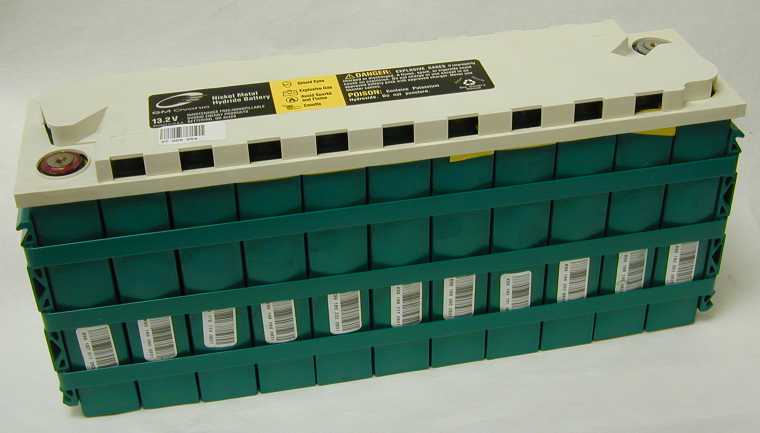
Battery Dimensions: L= 410mm, W= 102mm, H= 180mm, Weight= 40lbs
|